EU Inc. as the new European standard? The Council’s position and what remains of the European company for startups
On 23 October, the Council of the EU adopted its negotiating mandate on EU Inc. We look at what it changed in the Commission’s proposal: the fast-track procedure, registration checks, employee stock options and the implementation period.
Registering a company within 48 hours for around 100 euro, with share capital of zero euro, sounded like a promise to every startup in Europe. On 23 October, the Council of the EU published its position on EU Inc. and clearly narrowed part of that promise. Ireland’s Minister for Enterprise, Peter Burke, called EU Inc. a “foundational pillar” of Europe’s competitiveness ambitions, so it is worth checking how much of that pillar is left.
In this article you will learn
- what EU Inc. is meant to be and how the European Commission proposed it,
- what the Council of the EU changed in its negotiating mandate,
- who qualifies for the fast-track procedure and how the Council tightened registration checks,
- what happened to employee stock options and the solutions for tokenisation,
- when the first EU Inc. companies may realistically appear and whether tax residency rules change.
What is EU Inc. and what did the Council of the EU change?
EU Inc. is meant to be a legal form available in every Member State, registered in the national register and based on uniform rules on capital, shares and corporate bodies.
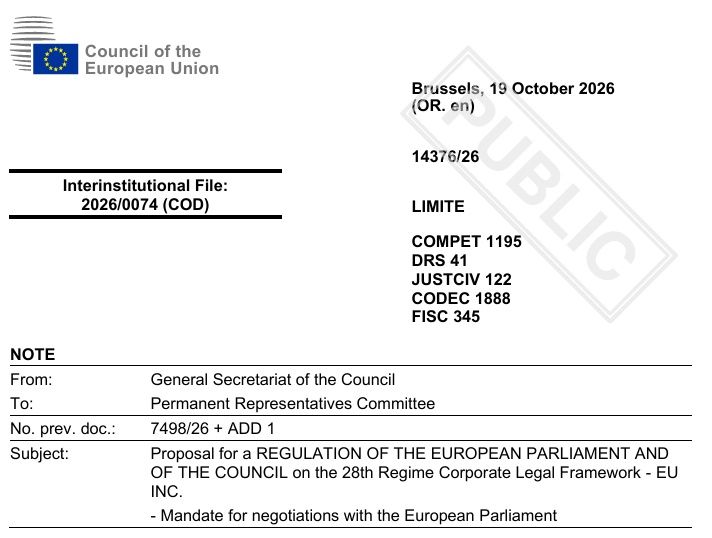
On 23 October, the Council of the EU published its position, that is, its negotiating mandate on EU Inc. The new EU-wide legal form (the so-called 28th regime), proposed by the Commission in March, was supposed to be registered within 48 hours for around 100 euro. The Council took a cautious approach and changed the conditions originally promised by the Commission. We look at what changed between the two texts and what European startups can expect from this new solution.
How do capital and share transfers work in EU Inc.?
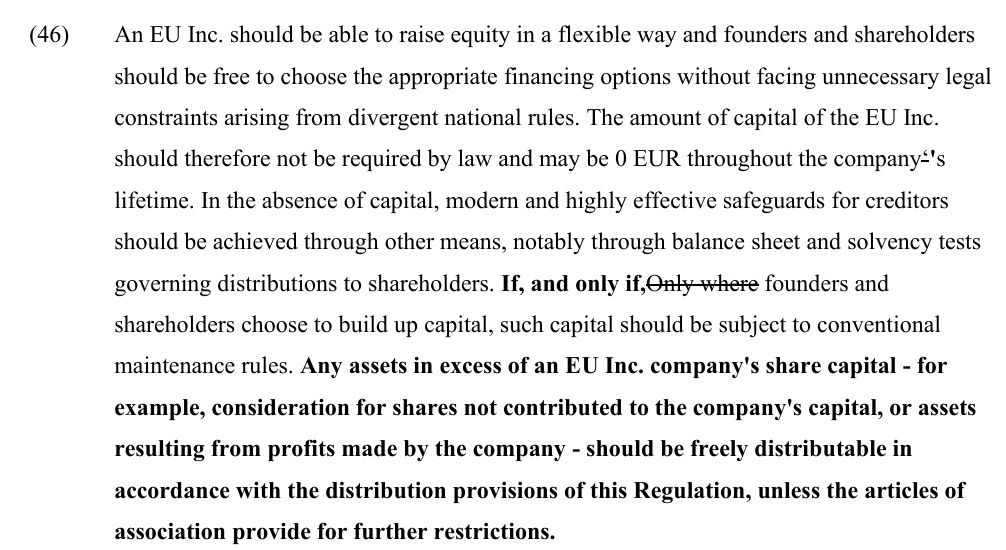
Share capital can be exactly zero euro. Creditors are protected by a balance sheet test and a solvency test, signed by the entire management board. Shares can be transferred entirely online.
Who can use the fast-track registration procedure?
The fast-track procedure applies only to a standard-template company. The Council limited the simplified procedure to cases where the company is set up using the model articles of association, without capital contributions and without contributions in kind. A company that needs articles tailored to its own needs from day one will go through the standard national procedure.
How did the Council tighten registration checks?
The Council clearly tightened control. Member States may suspend or refuse registration on the basis of AML and criminal law provisions, and a provision on wholly artificial arrangements was added to the text. Future members of the management board must identify themselves electronically, and at least one of them must reside in the EU. An agent cannot file the application on their behalf.
What did the Council change in employee stock options and taxes?
Employee stock options generated the most controversy during the consultation on the draft. The Council kept the scheme that allows companies to grant employees options over shares, but it narrowed the solution that defers taxation until the shares are sold. It will cover only companies with fewer than 750 employees and up to EUR 150 million in turnover. Member States also prepared a separate statement that the tax provisions in this act are an exception. Taxes will therefore remain the most difficult subject of the negotiations. The chapter on simplified insolvency for startups has disappeared from the text.
Which solutions survived in the draft after the Council’s review?
Several important solutions remain in the draft:
- shares with no nominal value make it easier to settle investment agreements converted into shares at a variable price,
- the management board can receive authorisation to issue shares excluding pre-emption rights,
- the share register may be kept on a blockchain, but every payment for shares must go through a payment, financial or credit institution.
Projects that wanted to tokenise shares will feel this restriction, especially as financial instruments rules still apply to such shares.
What should you consider when planning a structure with EU Inc.?
Two things should be kept in mind when planning structures. You can freely choose the country of registration, but the regulation does not change tax residency. A company registered abroad and managed from Poland will still pay tax in Poland.
The second matter is time. The Council extended the implementation period to 21 months, and the Parliament has not yet adopted its position, so the first EU Inc. companies will realistically appear in 2028 or 2029.
Will EU Inc. become a real alternative to a limited liability company?
Whether EU Inc. proves to be a “foundational pillar” of Europe’s competitiveness ambitions depends above all on how Member States fill the gaps. In Poland, this will be decided by an implementing act, and as the example of MiCA shows, implementing acts do not move quickly here. We are therefore waiting for the designation of the company form whose provisions will supplement the regulation, of the supervisory authority and of the role of the notary, as well as for the answer to whether EU Inc. will become a real alternative to the simple joint-stock company and the limited liability company.
FAQ
- When did the Council of the EU adopt its position on EU Inc.? On 23 October. It is a negotiating mandate, and the European Parliament has not yet adopted its own position.
- How much was registration of EU Inc. supposed to cost and how long was it supposed to take under the Commission’s proposal? Around 100 euro and 48 hours.
- Who can use the fast-track procedure? Only companies set up using the model articles of association, without capital contributions and without contributions in kind.
- Can a Member State refuse to register an EU Inc.? Yes. Member States may suspend or refuse registration on the basis of AML and criminal law provisions.
- Can an agent file the registration application? No. Members of the management board must identify themselves electronically, and at least one of them must reside in the EU.
- Does EU Inc. change a company’s tax residency? No. A company registered abroad and managed from Poland still pays tax in Poland.
- When will the first EU Inc. companies appear? The Council extended the implementation period to 21 months, so the first companies will realistically appear in 2028 or 2029.