Hedge Fund in Luxembourg: RAIF, SIF or Unregulated SCSp?
RAIF, SIF or unregulated SCSp? See how Luxembourg fund structures differ in cost, supervision, investor requirements and taxes, and which one to pick.
Luxembourg has long been one of the most popular jurisdictions for investment funds, yet choosing the right structure can overwhelm even experienced investors. The options include the RAIF, the SIF, the SICAR, and structures that are not funds at all under the product laws. Below, I walk through how this looks for a hedge fund aimed at a closed circle of private investors: what it costs and when each option makes sense.
In this article
- why a hedge fund in the EU is, as a rule, an alternative investment fund
- how the RAIF, the SIF and the unregulated SCSp differ
- who can invest in each structure and what the minimum capital is
- how much it costs to run the fund and how long it takes to launch
- how the RAIF, the SIF and the SCSp are taxed
- which structure to choose at a smaller scale
How does the EU classify a hedge fund?
EU law splits funds into two separate groups. The first is retail UCITS funds, governed by Directive 2009/65/EC, which can be sold to anyone. That is why they face very strict protective rules: they must invest in liquid, listed instruments, diversify risk well and cannot borrow heavily.
The second group is alternative investment funds, or AIFs. It includes hedge funds, private equity and real estate funds, in other words every fund that is not a UCITS. A hedge fund for a closed circle of private investors will therefore as a rule qualify as an AIF, regardless of the national legal regime chosen.
What is the AIFMD and why does a fund need an AIFM?
Alternative funds are covered by the AIFMD (Directive 2011/61/EU). It is worth knowing that it does not regulate the fund itself, but the entity that manages it, the AIFM (Alternative Investment Fund Manager). This is why a licensed manager is required even though the fund itself is not always subject to approval by a supervisor. In practice, the AIFM is usually an external, licensed firm serving many funds of different clients.
The obligation to obtain authorisation in the home country applies only above a certain scale: EUR 100 million of assets under management where the fund uses leverage, or EUR 500 million where it does not use leverage and does not allow redemptions during the first 5 years. Below these thresholds the manager can operate under a lighter regime by registering with the local regulator. Passporting a fund across the EU applies only to institutional clients, so it does not matter when selling to well-informed investors. The AIFMD has recently been amended (AIFMD II, Directive 2024/927). Luxembourg implemented it through a law that entered into force on 16 April 2026, and the changes concern, among other things, substance requirements, delegation of management and liquidity management tools. They did not, however, change the architecture described here.
What fund structures are available in Luxembourg?
The main differences are shown in the overview below.
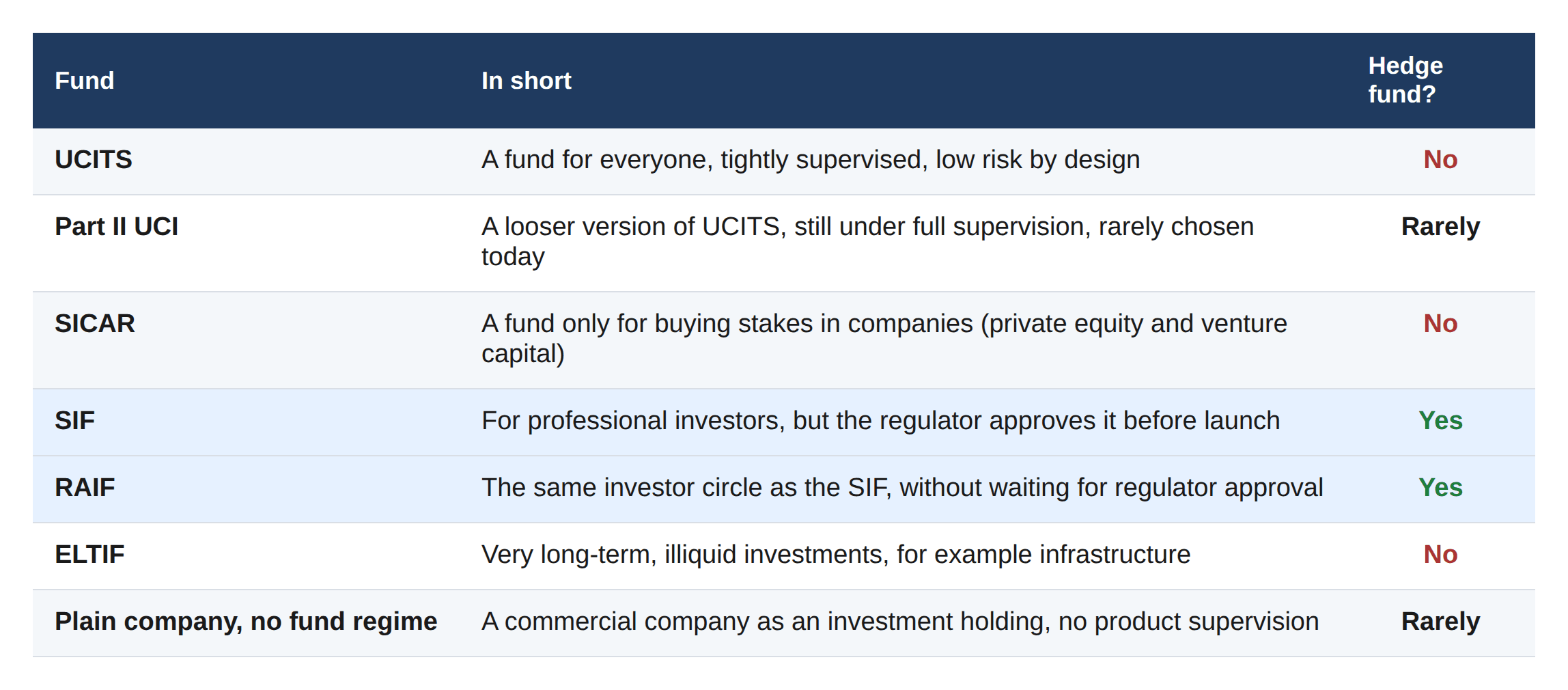
The split between regulated and unregulated concerns only the Luxembourg level of product approval by the CSSF (the local counterpart of the Polish KNF). The SIF is regulated, the RAIF is not. Both categories are, however, fully covered by the AIFMD at the manager level, so unregulated does not mean unsupervised, only without direct approval of the product by the CSSF.
Which legal forms can be used?
A fund must take one of several legal forms. The options include the FCP (a common pool of assets managed externally, in which investors have no vote), the public limited company SA, the small private company Sàrl, rarely used as a fund itself, and the SCS and SCSp, flexible contractual partnerships common in private equity and venture capital.
On top of these come the SICAV and SICAF statuses. A SICAV has variable capital that rises and falls with subscriptions and redemptions, without shareholder resolutions or a notarial deed, so it suits funds from which investors want to withdraw money regularly. A SICAF has fixed capital and changing it requires a formal decision, so it suits funds where money is locked up for years anyway.
What sets the RAIF apart?
The RAIF is today the market standard for new alternative funds in Luxembourg. It suits many strategies, including hedge funds, private equity, real estate and private debt. It is a solution that is quick and cheap to start, but it requires a minimum business scale. Importantly, a RAIF can take the form of an SCSp, SCS, SCA, SA, S.à r.l. or FCP. For a private fund, combining a RAIF with an SCSp is often attractive, because it gives the contractual flexibility of the SCSp while still allowing use of the fund infrastructure and the EU marketing regime.
The requirements are as follows:
- investors: well-informed investors only, meaning an investment of at least EUR 100,000, a written assessment by a bank, investment firm or management company confirming the investor's knowledge and experience, or professional or institutional investor status with no minimum amount,
- capital: minimum EUR 1,250,000 of net assets, to be reached within 24 months of launch, where an investor may pay in 5% of the committed amount at the start and the rest on the fund's call,
- parties: a mandatory external, authorised AIFM, which must have at least two conducting persons working full-time and, in principle, permanently present in Luxembourg (this follows CSSF practice, and under AIFMD II these persons must also be resident in the EU), plus a depositary, an auditor and an administrator, all with real presence in Luxembourg,
- time to launch: roughly 2 to 4 weeks (up to 10 weeks in some sources), because there is no CSSF approval, only registration.
Costs are roughly 1.7 to 2.5% of assets per year for smaller funds, for example EUR 170,000-250,000 a year for a EUR 10 million fund. This is mainly due to fees for a third-party AIFM, usually EUR 75,000 to 100,000 a year regardless of the fund size. The realistic break-even point for a RAIF is around EUR 20-30 million.
When to choose a SIF instead of a RAIF?
The SIF allows practically the same strategies as the RAIF, including hedge funds, and the investor base, required capital and investment amount are the same. The difference is only in the level of supervision: the CSSF directly approves and verifies the board, administrator, depositary and auditor before the fund starts. This affects timing, because launch takes roughly 4 to 6 months (some sources give less, from 2 to 5 months), and cost, because a one-off fee for reviewing the application and an annual supervisory fee to the CSSF are added.
A SIF makes sense only where a specific, large institutional investor, for example a pension fund, explicitly requires a product directly supervised by the CSSF. Otherwise it is a waste of time and money compared with a RAIF, with an identical scope of activity.
Is an unregulated SCSp a good alternative?
The SCSp is a flexible Luxembourg limited partnership without legal personality. It has no statutory minimum capital, and the partnership agreement can regulate relations between partners very broadly: capital calls, waterfall, carried interest, lock-up, redemption and investment rights. At a smaller capital and with a closed circle of investors it is a much cheaper alternative to the RAIF and the SIF.
The structure does not require well-informed investor status, because that requirement exists only in the RAIF, SIF, SICAR and Part II laws. Creating one requires at least one general partner, which can be another company, and one limited partner. Launch usually takes 2 to 4 weeks once the partnership agreement is settled.
Keep in mind, however, that unregulated does not mean outside the AIFMD. If an SCSp raises capital from more than one investor, has a defined investment policy and invests for their benefit, it can meet the definition of an AIF even if it is not itself a fund under the SIF or RAIF law. In such a model a manager that is an AIFM is needed. Below the EUR 100 million and EUR 500 million thresholds, registration with the CSSF is enough, and above them full authorisation is required. The CSSF also provides reporting procedures for Luxembourg AIFs not authorised by the CSSF.
Among the drawbacks are the lack of fund infrastructure, the greater importance of drafting the partnership agreement properly, potentially harder fundraising and marketing, and the absence of a statutory umbrella structure.
How are the RAIF, the SIF and the SCSp taxed?
As a rule, the RAIF and the SIF are not subject to corporate income tax, municipal business tax or net wealth tax. They do pay an annual tax of 0.01% of the managed capital, with statutory exemptions. At EUR 10 million of capital this is roughly EUR 1,000 a year, and at EUR 20 million roughly EUR 2,000 a year. Distributions to investors are generally not subject to withholding tax, but the taxation of the investor in their country of tax residence has to be analysed.
The SCSp is, as a rule, tax transparent for Luxembourg income tax purposes: the partnership itself is generally not a corporate income taxpayer, and the taxable result is allocated to the partners. It is also not subject to net wealth tax or to the annual tax applicable to the SIF and the RAIF, which is one of the significant cost advantages of this structure. In certain cases, for example where the general partner is a capital company holding at least 5% of the interests, municipal business tax may nevertheless apply, so the structure needs to be checked individually.
Which structure to choose for EUR 10-20 million of capital?
For a fund with managed capital of around EUR 10-20 million, aimed at a closed circle of private investors, the most practical option is an unregulated structure, then a RAIF, and possibly a SIF. The annual costs of a RAIF and a SIF can be high enough that, at this scale, the solution simply does not pay off. The 0.01% annual tax is of relatively little importance in the fund's total running costs.
Frequently asked questions about funds in Luxembourg
- Is a hedge fund in Luxembourg always an AIF? Yes, as a rule. Under EU law a hedge fund for a closed circle of private investors qualifies as an alternative investment fund, regardless of the national legal regime chosen.
- What is the difference between a RAIF and a SIF? Mainly the level of supervision. A SIF requires prior approval by the CSSF, while a RAIF is not subject to direct authorisation of the product. The range of permitted strategies is analogous.
- Does an unregulated SCSp mean no supervision? No. It means no direct authorisation of the product by the CSSF, but the structure can be an AIF and require a manager that is an AIFM (at a smaller scale, registration is enough) and reporting.
- How long does it take to launch a fund? A RAIF and an SCSp roughly 2 to 4 weeks, a SIF several months because of the CSSF approval procedure.
- Who can invest in a RAIF or a SIF? Well-informed investors, meaning people investing at least EUR 100,000, people with a written assessment confirming their knowledge and experience, or professional or institutional investors. There is no statutory threshold for an SCSp.
- Is a RAIF worth it at a small capital? Usually not. The realistic break-even point is around EUR 20-30 million, and the annual costs for smaller funds are 1.7-2.5% of assets.